



Cart
Your shopping cart is empty!
It's never too late to make things right :)



Copied
Humans have five senses, each of which plays a vital role in perceiving the world around us: sight, hearing, taste, smell, and touch. When one of them stops functioning properly, it affects the entire body. However, in today’s world, there are solutions for every situation, and life becomes full again, filled with sensations, sounds, and colors. Today we’ll talk about how modern hearing aids improve quality of life.
Medica+, a brand that creates innovative devices based on Japanese technology, has made it its mission to improve the quality of life for its customers. Medica+ hearing aids not only restore hearing ability but also open up a new world of sounds, making every day brighter and more fulfilling. They provide high-quality sound, comfort, and ease of use, allowing you to enjoy life in all its aspects.
Trust in Medica+ is based on the state-of-the-art technologies used in the production of hearing aids. These devices help people with hearing loss rediscover the joy of communication, enjoy music, and fully engage in all aspects of life. Medica+ hearing aids make the world louder, clearer, and more vibrant, restoring a true quality of life to their users.
Analog hearing aids are devices that amplify all sounds equally using simple electronic circuits. They are suitable for people whose hearing loss is due to a middle ear condition. They have limited adjustment capabilities compared to digital hearing aids and may amplify background noise, which reduces sound quality.
Digital hearing aids are devices that convert sound waves into digital signals, enabling more precise sound processing, noise filtering, and customization to the user’s individual needs. Medica+ has developed precisely such versatile hearing aids; these devices are equipped with a Japanese microchip that ensures multidimensional sound processing. As a result, the hearing aids suppress external noise. You hear only clear sound and can understand the speaker’s speech even in a crowded place. All Medica+ hearing aids are comfortable to use and virtually invisible to others.
The principle of operation of analog hearing aids is based on the mechanical amplification of sound waves. Sound enters the device’s microphone, where it is converted into an electrical signal. This signal passes through an amplifier, which increases its power. The amplified signal is then transmitted to a miniature speaker, which converts it back into sound waves, but at a higher volume. These amplified sound waves are directed to the user’s ear. Analog hearing aids have limited filtering and adjustment capabilities, so they amplify all sounds equally, including unwanted noise.
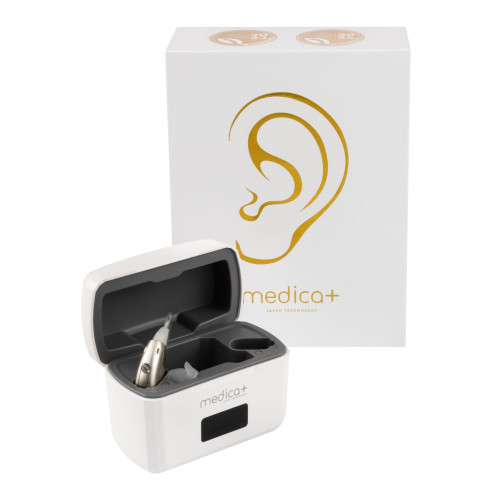
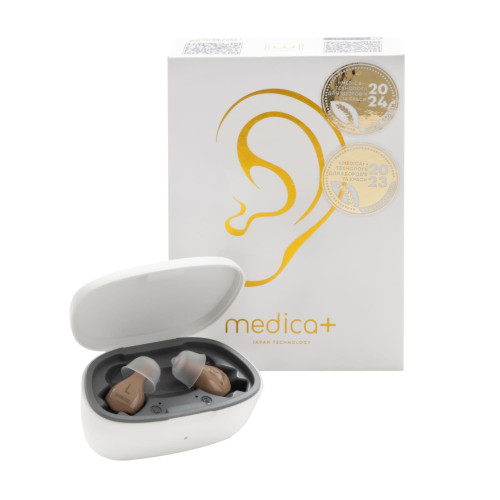
The Medica+ line of hearing aids includes several models suitable for people with varying degrees of hearing loss—from mild to severe. Thanks to the versatility of these devices, everyone can find the perfect solution for their needs. (Here are photos of all three hearing aid models)
Medica+ universal hearing aids offer significant advantages over analog devices. Thanks to the use of modern Japanese technologies, they provide high sound quality, wearing comfort, and a wide range of settings. Digital signal processing significantly reduces background noise, improves speech clarity, and ensures a more natural sound experience. Modern Medica+ digital hearing aids stand out for their sleek design and minimal weight, ensuring comfort and discretion for those around you. By choosing Medica+ hearing aids, you are choosing innovative technology, comfort, and reliability. These devices not only improve your quality of life but also open up new possibilities for communication and enjoying the sounds of the world around you. Experience the harmony of sound and live life to the fullest with Medica+.
Based on signal processing, hearing aids are divided into analog and digital. Based on configuration—both analog hearing aids and those with digital sound processing—can be either trimmed or programmable.
Adjustable hearing aids are configured using special controls (potentiometers) that change specific acoustic parameters of the device. These settings are adjusted manually by a specialist and are usually limited to a few basic parameters: overall gain, and low- and high-frequency gain.
Programmable hearing aids are configured using a computer and special software. This allows for a more precise adjustment of the device to the user’s individual hearing characteristics. Programmable hearing aids offer more options for precise adjustment of various parameters, including compression and noise reduction, and may also feature several programs tailored to different acoustic situations.
Based on the method of sound transmission, hearing aids are classified into the following types:
Bone-conduction hearing aids are used only in specific cases. In most cases, these devices are used when air-conduction hearing aids cannot be used.
Types of hearing aids include:
Each type has its own advantages and specific applications, depending on the degree of hearing loss, the user’s ear anatomy, and their individual needs.
Medica+ universal hearing aids stand out for their advanced technologies and functionality. They are equipped with a Japanese digital microchip that ensures comprehensive sound processing and effective suppression of ambient noise. These devices offer the convenient option of charging via a USB port from various sources, including smartphones, power banks, and computers. An important feature is their symmetrical design, which allows the hearing aids to be worn in either ear. The quality and safety of Medica+ models are confirmed by the Ukrainian SES certificate, the European ISO/SE/RoHS standards, and the U.S. FDA certification.
The set includes a special protective case for storage and transport, which protects the hearing aid from damage and moisture. In most models, it also serves as a charger. Additionally, each set includes 3–4 ear tips (depending on the hearing aid model). The set also includes a special brush for regular maintenance of the hearing aid, which helps keep it clean and extends the device’s lifespan.
Ear tips are an important component of hearing aids, ensuring comfortable and effective use of the device. They create a tight seal between the hearing aid and the user’s ear. A properly fitted ear tip ensures comfort and improves sound quality. When selecting a silicone earpiece, the size of the ear canal must be taken into account. The earpiece should fit snugly against the ear. Earpieces require regular cleaning to maintain hygiene and ensure the hearing aid functions effectively. Over time, earpieces wear out and need to be replaced to ensure optimal performance of the hearing aid.
Sound-conducting tubes are equally important components of hearing aids, especially behind-the-ear models. The tubes transmit amplified sound from the hearing aid to the ear canal. They come in various lengths and diameters that can be customized to fit the user’s individual ear anatomy. They require regular cleaning to remove earwax and ensure high-quality sound transmission. It is recommended to replace them every 3–6 months to maintain sound transmission quality. A properly selected and well-maintained tube ensures clear and comfortable sound transmission. You can always purchase a set of replacement tips for any hearing aid model on the Medica+ website.
Medica+ hearing aids are designed with the individual needs of users in mind to ensure maximum comfort and improve quality of life. The company’s managers are always ready to help you choose the best option for your specific situation, providing a personalized approach and maximum comfort for their customers.

Японские технологии,
которые превышают ожидания
На первую покупку


